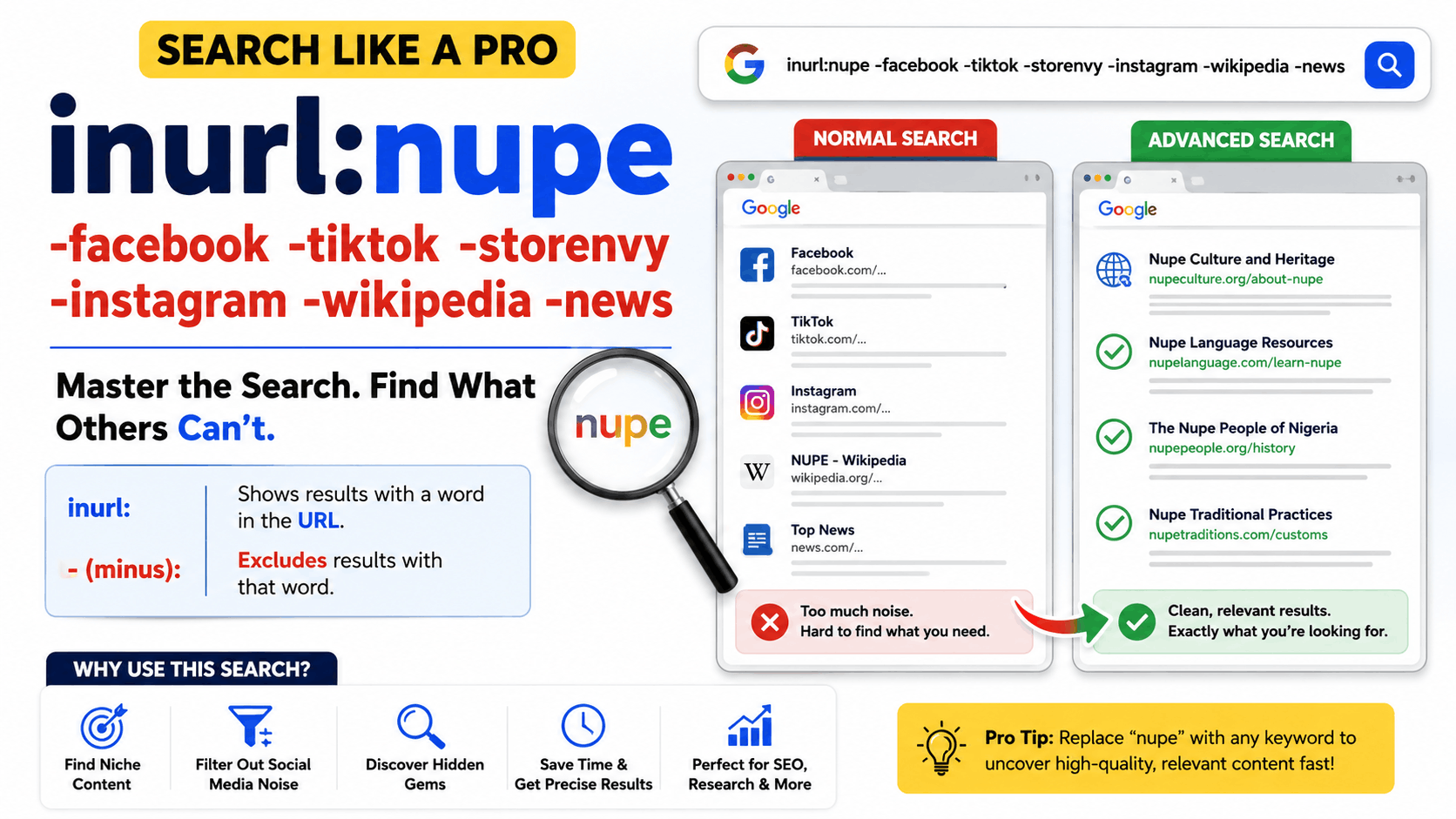
When you need to find something specific on the internet, a standard Google search often feels like looking for a needle in a haystack. You type in a keyword and get millions of results—most of them completely irrelevant. That’s where advanced search operators come in, and one of the most powerful combinations you can use is inurl:nupe -facebook -tiktok -storenvy -instagram -wikipedia -news. This search string is a precision tool that helps you cut through the noise and find exactly what you’re looking for.
In this guide, we’ll break down exactly how this search works, why you’d use it, and how you can apply it to your own research, SEO work, or content discovery. By the end, you’ll be a pro at using search operators to find hidden gems on the web.
What Does “inurl:nupe -facebook -tiktok -storenvy -instagram -wikipedia -news” Actually Mean?
Let’s dissect this search string piece by piece so you understand the power behind each operator.
The inurl: Operator Explained
The inurl: operator is a Google advanced search command that tells the search engine to only return results where a specific word or phrase appears in the URL of the page . For example, a search for inurl:blog would only show pages that have the word “blog” in their web address. It’s incredibly useful when you want to find pages of a certain type or structure .
The Exclude Operator (-)
The minus sign - is the exclude operator. When you put a minus sign in front of a word, you’re telling Google to remove any result that contains that term . So in our string, -facebook means “show me results that don’t have the word ‘facebook’ anywhere on the page.”
Putting It All Together
When you combine these operators, you get a search that finds pages where “nupe” appears in the URL, but removes any results that mention Facebook, TikTok, Storenvy, Instagram, Wikipedia, or news sites. This is brilliant for finding niche content about “nupe” that isn’t buried under social media profiles, e-commerce stores, encyclopedia entries, or news articles.
Why Would You Use This Search String?
There are several practical reasons why someone might use this specific combination of search operators. Let’s explore the most common use cases.
Finding Nupe-Related Content Without Social Media Noise
The term “NUPE” has several meanings. It can refer to the National Union of Public Employees, a UK trade union , or the Nupe people and language of west central Nigeria . It’s also used in slang contexts on social media . A regular Google search for “nupe” would bring up a messy mix of union websites, Instagram profiles, TikTok videos, and Wikipedia pages. By using this specific string, you can filter out the noise and focus on other types of content.
The “NUPE” Search String as a Template for Other Keywords
The true power of inurl:nupe -facebook -tiktok -storenvy -instagram -wikipedia -news isn’t just about “nupe.” It’s a template you can adapt for any keyword. Let’s say you’re researching a specific product, a niche hobby, or an obscure topic. You can replace “nupe” with your keyword and instantly have a refined search that filters out social media, retail sites, encyclopedias, and news.
Practical Example: Searching for “surfing”
Imagine you’re researching “surfing.” A normal search would bring up surf shops, Instagram influencers, Wikipedia articles about the sport, and news stories about surfing competitions. But if you want to find local surf blogs, personal websites, or niche forums, you could use:
text
inurl:surfing -facebook -tiktok -storenvy -instagram -wikipedia -news
This search would give you a much cleaner set of results, focusing on sites that have “surfing” in their URL but aren’t the usual big-name platforms.
How to Use This Search in Practice
Now that you understand the components, let’s look at how you can apply this technique in real-world scenarios.
Use Case 1: SEO Competitor Research
SEO professionals often use the inurl: operator to find how competitors structure their URLs . For example, if you’re in the travel niche and want to see how other sites organize their destination guides, you might search for:
text
inurl:destinations -facebook -tiktok -instagram
This could reveal travel blogs, niche tourism sites, and community forums that might be valuable for backlink opportunities or content inspiration.
Use Case 2: Finding Discussion Forums and Communities
Many forums and community boards have URLs that include words like “forum,” “community,” or “discuss.” If you want to find a forum about “surfing” that isn’t on a major social platform, you could use:
text
inurl:surfing inurl:forum -facebook -reddit -quora
This finds pages with both “surfing” and “forum” in the URL and excludes major Q&A and social sites.
Use Case 3: Academic and Research Purposes
Students and researchers often need to find primary sources or niche reports that aren’t on Wikipedia or in the news. For example:
text
inurl:climate -wikipedia -news -site:gov
This could help find academic papers, NGO reports, or independent research sites with “climate” in the URL.
Use Case 4: Discovering New Brands and Products
If you’re a buyer or a journalist looking for emerging brands in a particular niche, you can use this search string to get away from the big retailers. For example:
text
inurl:bags -amazon -etsy -storenvy -shopify
This might help you find independent designers, small-batch manufacturers, or craft blogs that talk about bags but don’t sell them on major e-commerce platforms.
Frequently Asked Questions (FAQ)
Q1: What does the inurl: operator do exactly?
The inurl: operator tells Google to only show pages that have a specific word or phrase in the URL itself . For instance, inurl:seo-guide would only return pages with “seo-guide” in their web address. It’s a powerful way to search within a page’s structure.
Q2: Why are there so many exclusions in the “inurl:nupe” search?
The exclusions -facebook -tiktok -storenvy -instagram -wikipedia -news are used to filter out the most common types of sites that would normally dominate a search for a term like “nupe.” This helps you discover more niche, independent, or specialized content .
Q3: Can I use this search template for any keyword?
Absolutely! The search string inurl:KEYWORD -facebook -tiktok -storenvy -instagram -wikipedia -news can be adapted by simply replacing “KEYWORD” with whatever you are searching for. It’s a highly versatile template .
Q4: Are there other useful search operators I should know about?
Yes! Other very useful operators include site: to search within a specific website, intitle: to find a word in a page’s title, and filetype: to find specific file types like PDFs . You can combine these with inurl: for even more precise searches.
Q5: Does this work on Bing or other search engines?
Most major search engines like Google, Bing, and Yahoo support basic search operators like inurl: and the minus sign - . However, some operators might have different names or syntax (e.g., inrul: is a common typo for inurl:), so it’s always good to check the specific engine’s help documentation.
Conclusion: Unlock the Full Potential of Google Search
The search string inurl:nupe -facebook -tiktok -storenvy -instagram -wikipedia -news is more than just a random combination of words and symbols. It’s a master key that unlocks the deeper, less obvious corners of the internet. By using inurl:, you’re telling Google exactly where to look—in the URL. And by using the minus sign, you’re telling it what to ignore.
This simple but powerful technique is invaluable for researchers, SEOs, content creators, and anyone who wants to find high-quality, relevant information without the noise of social media, e-commerce, and major news outlets. So next time you need to find something specific, don’t just type in a keyword. Use the power of advanced search operators to get exactly the results you’re looking for.